Since Google I/O 2026, AI Mode is the default search experience worldwide: the AI answer renders above the blue links, and organic clicks are collapsing on covered queries. But the data tells a different story than apocalypse: brands cited inside the answer capture more clicks than a classic position 1. The mechanics have changed — keyword-to-click → context-to-citation — and this guide walks through how to make the switch.
- I/O 2026 (May 19): AI Mode becomes the global default, with background agents that keep searching on the user's behalf.
- Clicks are falling: −18% on position 1 when an AI answer is displayed; zero-click searches up from 54% to 72%.
- But the citation pays: +35% organic clicks vs an uncited position 1, +91% on paid vs uncited competitors.
- New mechanics: context-to-citation — be the source of the answer, not the link below it.
- The levers: answer-first content + semantic cluster + demand signal.
What did Google announce at I/O 2026?
On May 19, 2026, Google made official what the curves had been signaling: AI Mode — Search's conversational interface, powered by Gemini — becomes the default experience, desktop and mobile, everywhere. No longer a tab to switch on: the entry point. At announcement time, AI Mode had already passed one billion monthly users, with query volume doubling every quarter.
Two secondary announcements matter just as much for brands:
- Background agents: agents that keep searching after the session — monitoring, comparisons, price tracking. Part of search now happens with no human in front of the screen; the user only sees the synthesis.
- Expanded agentic checkout: a purchase can fire straight from the answer, no detour through your site.
The blue links still exist. But they sit behind the answer, and the answer cites its sources. The whole question becomes: are you in it?
Is the organic click really collapsing?
Yes — every study agrees on the direction; only the amplitude varies with methodology.
Sources: Ahrefs / BrightEdge trackers (March 2026); ISB × Carnegie Mellon randomized study, Jan–Feb 2026 — the first run in a real browsing environment; Seer Interactive analyses.
The breakdown by intent is even more brutal: informational categories — definitions, explainers, how-tos — lose 30 to 40% of their traffic, because the AI answer is enough. It's the logical next step of the search shift to AI: search volume isn't dropping — the click is what's disappearing from the journey.
Why does getting cited pay more than position 1?
Because the AI answer pre-qualifies the click. Seer Interactive's analyses across millions of impressions show that sites cited inside the AI Overview get +35% organic clicks versus an equivalent uncited position — and +91% paid clicks versus uncited competitors on the same queries.
Position 1 below an AI answer is a consolation prize. The citation inside the answer is the new position 1.
The operator read: traffic is getting scarcer, but hotter. The user who clicks has already read the synthesis — they arrive to dig deeper, compare, or buy, not to discover. And background agents widen that filter: the agent reads ten sources, the human visits one. If you're not cited, you don't exist in that journey.
Keyword-to-click vs context-to-citation: what actually changes?
Explicit definitions. Keyword-to-click: optimizing a page for a keyword to win a click from the SERP. Context-to-citation: optimizing an entity — brand, content, mentions — to be retained as a source in the generated answer. This isn't an SEO rebrand: the optimization unit, the KPI, and the external asset all change.
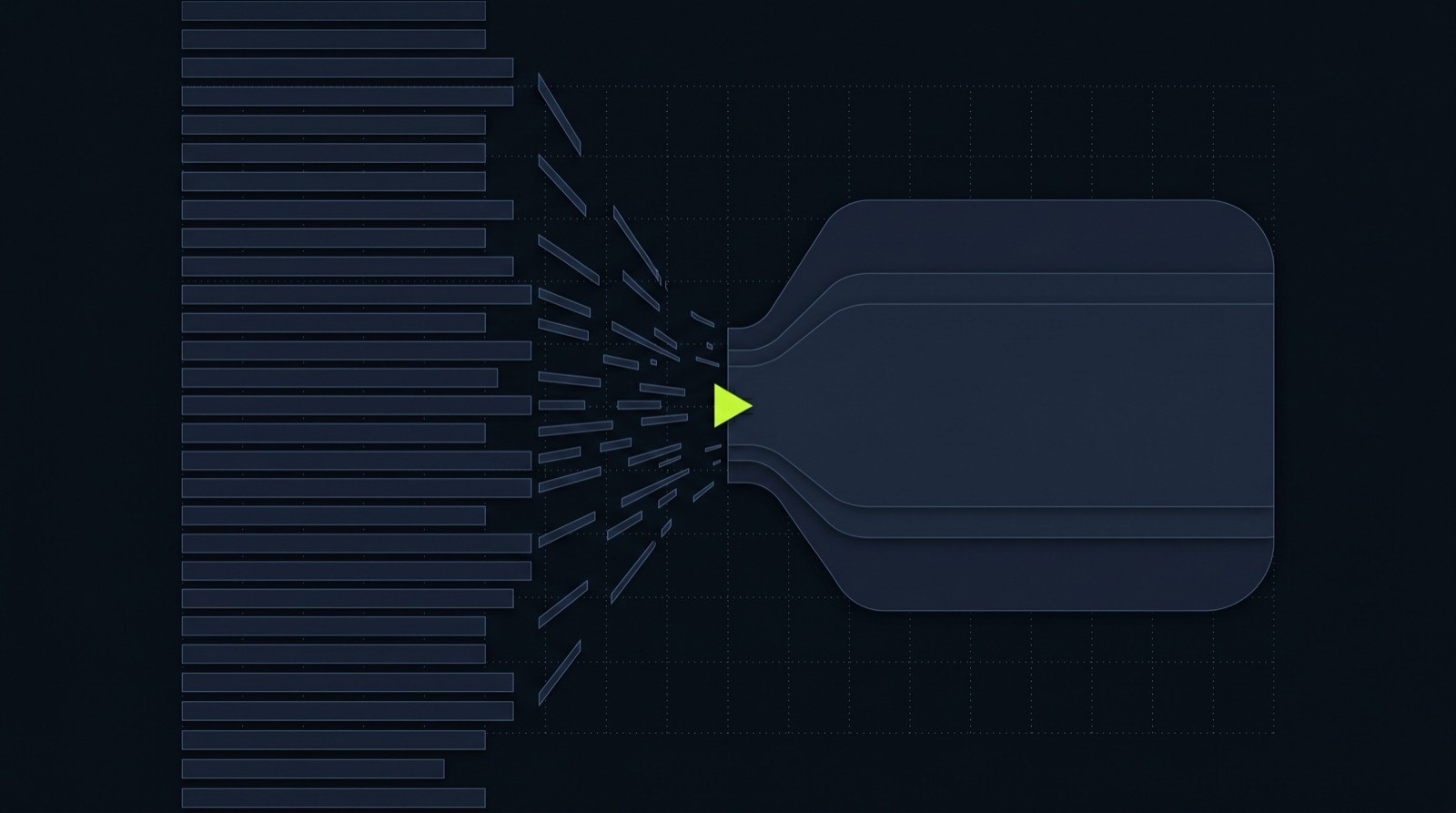
The technical reason: AI Mode runs query fan-out — it decomposes your query into dozens of sub-queries, hits the index, then synthesizes. You're no longer optimizing for a keyword: you're optimizing for the bundle of sub-questions a model asks around your category.
How do you switch to context-to-citation, concretely?
The switch isn't a hack — it's a sequence. Here's the one that holds up.
- 011 — Map the semantic cluster30 to 80 searches covering your category's buying intent — that's the target the query fan-out will probe. A single keyword no longer captures anything.
- 022 — Structure answer-firstEvery page answers a sub-question in its first two sentences: explicit definitions, H2s phrased as sub-questions, comparison tables, FAQ. Extractable content is cited content.
- 033 — Build the demand signalModels cite entities people talk about: third-party mentions, branded searches, conversations around the cluster. It's GEO's external asset — the one you work on, not the one you wait for.
- 044 — Measure citation rate, not positionTrack where your brand appears in AI answers, on which queries, against which competitors. Google position remains an input; the citation is the output.
- 055 — Cover beyond GoogleChatGPT, Claude, Grok, and DeepSeek don't cite the way AI Mode does. A single-platform strategy misses a growing share of queries.
On point 5: every AI platform cites differently, and that's exactly why multi-model measurement isn't optional. It's what the Rankfeed GEO platform is built for: measure your citation rate across the major models, then activate it through the demand signal — the full pipeline is on How it works.
Should you throw out classic SEO?
No. SEO is demoted, not dead: it remains the technical foundation (crawlability, structure, speed) that makes the citation possible. What dies is SEO as a complete strategy — optimizing for the click while the click disappears from the journey.
Reallocating effort after I/O 2026
With agents searching continuously on the user's behalf, part of search no longer has a "search moment." Your brand needs to be citable 24/7, across the whole cluster — not just performing on ten keywords at time T.
The takeaway
AI Mode by default doesn't erase organic distribution: it re-concentrates it on cited sources. The average click collapses; the cited click appreciates. Teams still steering by position are watching a KPI getting deindexed; teams steering by citation rate are playing the game as it's now configured.
Rankfeed measures your citation rate in AI answers and activates it through the demand signal — continuously, on the models that matter. Check Pricing or read the full pipeline before launching your first scan.
FAQ
Keep reading
- Every AI platform cites differently — why AI Mode is only one terrain among several.
- How LLMs choose who to cite — the source-selection mechanics.
- The search shift to AI in 2026 — the underlying numbers behind I/O 2026.
To measure, then activate, your citation rate: How it works and Pricing.