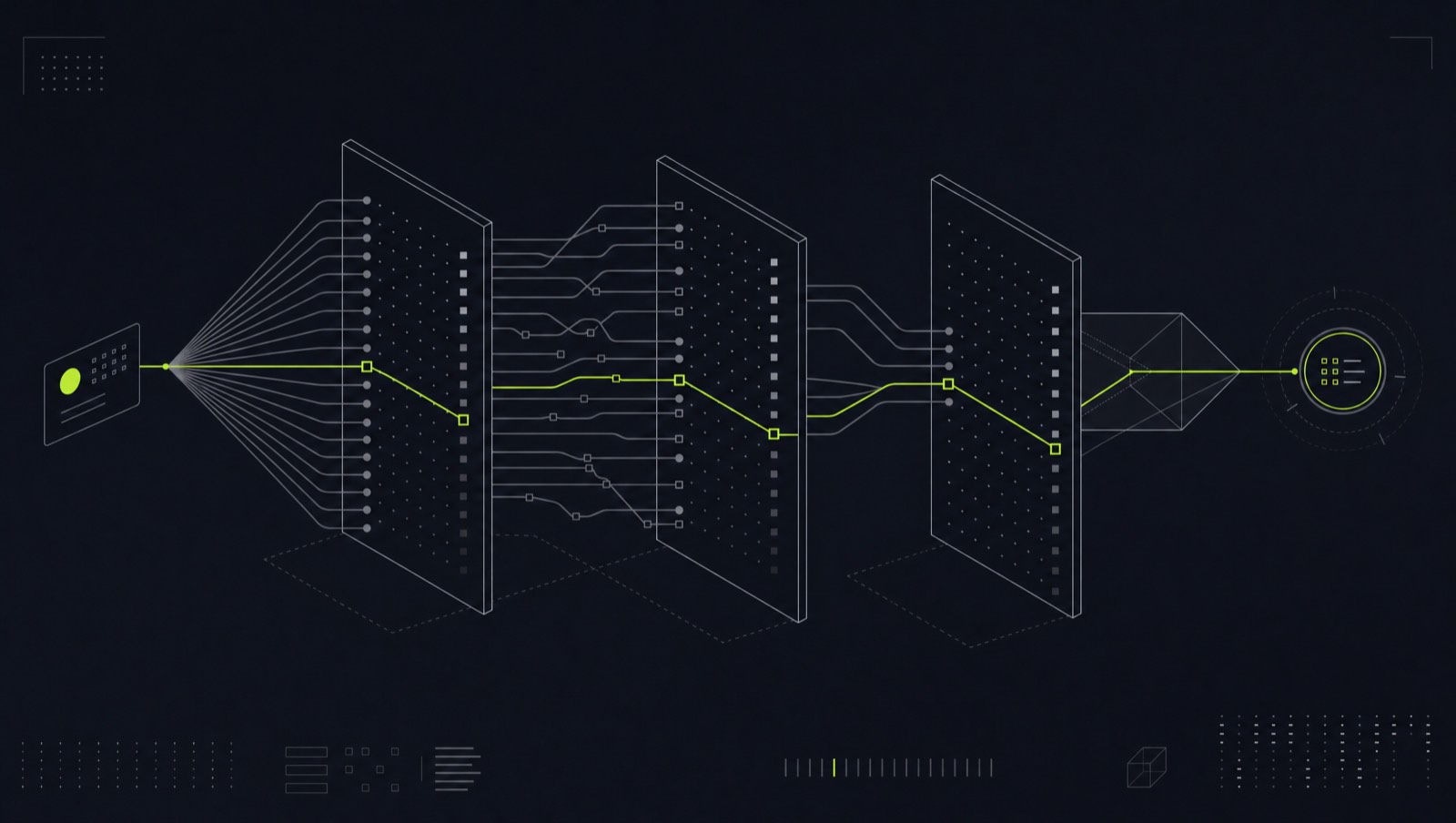
When you ask ChatGPT "what's the best tool for X?", the model doesn't pull a brand at random or recite a ranking carved into its weights. A citation passes through three stages — retrieval, selection, synthesis — and at each one, it's the demand signal, not your domain's authority, that does the sorting. Understanding this mechanism is understanding where to act.
- 3 stages: candidate retrieval → source selection → answer synthesis.
- The demand signal filters at each stage: an entity mentioned everywhere survives; an isolated domain is dropped.
- RAG: modern models retrieve relevant text, not a backlink graph.
- Extractability ≠ authority: structure helps you be read; demand decides you get cited.
- 4 models: ChatGPT, Claude, Grok, DeepSeek — same principles, different retrievals.
Definition: what is an LLM citation?
An LLM citation is the mention of a brand, product, or source in an answer generated by a language model, as an element of the response to a user intent. It can be linked (with a URL, as in Perplexity) or unlinked (a bare name cited, as often in ChatGPT). In both cases, it results from a selection process, not a fixed ranking.
The three stages of a citation
The journey of an answer, from prompt to cited brand, follows a stable sequence. Here's where each signal comes into play.
- 011 — RetrievalThe model generates queries derived from your question (query fan-out) and retrieves a pool of candidates: training passages and/or fresh web sources. The filter here is semantic relevance and entity presence. A brand never mentioned for this intent never enters the pool.
- 022 — Evidence selectionAmong the candidates, the model evaluates relevance, entity authority, and freshness. A brand described consistently across many sources is judged credible and retained. This is where aggregate demand beats a single site's authority.
- 033 — Response synthesisThe model integrates the selected sources into a fluent answer. The brand appearing across several selected sources is likelier to be named — the redundancy of the demand signal pays off one last time.
Where the sorting happens: demand vs authority, stage by stage
At each stage, two signals compete. The table below shows which one prevails, and why.
Retrieval-augmented generation fetches relevant passages by semantic similarity — not a backlink graph. That's the technical reason an unlinked mention (0.664 correlation) beats a backlink (0.218): the backlink simply isn't the signal the retrieval layer reads first.
The mistake of transposing the SEO reflex
Many teams apply Google-ranking logic to LLM citation. It's the most expensive mistake, because the two worlds don't read the same signals. Another major difference: there is no single AI ranking — AI citation fragmentation across platforms shows that on identical prompts, ChatGPT and Gemini share fewer than one cited domain in three.
Think LLM citation, not Google ranking
Query fan-out changes the target
A technical detail with major strategic consequences: AI engines don't query a single request. They generate several derived ones and synthesize the whole.
Optimizing for an exact keyword means aiming at a target the model has already shattered into ten variants. It's the whole semantic cluster you have to cover, not the keyword.
The consequence: a brand present across an entire cluster of intents is retrievable for each fan-out variant. A brand present on one exact keyword is invisible the moment the model rephrases. That's why LLM Seeding works in clusters — 30 to 80 searches per language — not by keyword.
From diagnosis to action
Understanding the mechanics answers "why am I not cited." The next question — "how do I get cited" — calls for action on the demand signal.
- 01Make the entity retrievableConsistent presence on the third-party sources LLMs read. The more your brand is described the same way everywhere, the better it survives retrieval.
- 02Make passages extractableSelf-contained answers, clear definitions, tables, FAQs. This helps selection, especially on Perplexity and Copilot.
- 03Create the demand signalGenerate natural conversations around your semantic cluster across ChatGPT, Claude, Grok, and DeepSeek. That's active LLM Seeding — producing the signal instead of waiting for it.
FAQ
Keep reading
- LLMs feed on user searches — the underlying postulate.
- Domain authority vs demand signal — the numbers behind it.
- The semantic cluster in GEO — why we work in clusters, not keywords.
To make your entity retrievable and create the signal: How it works and Pricing.