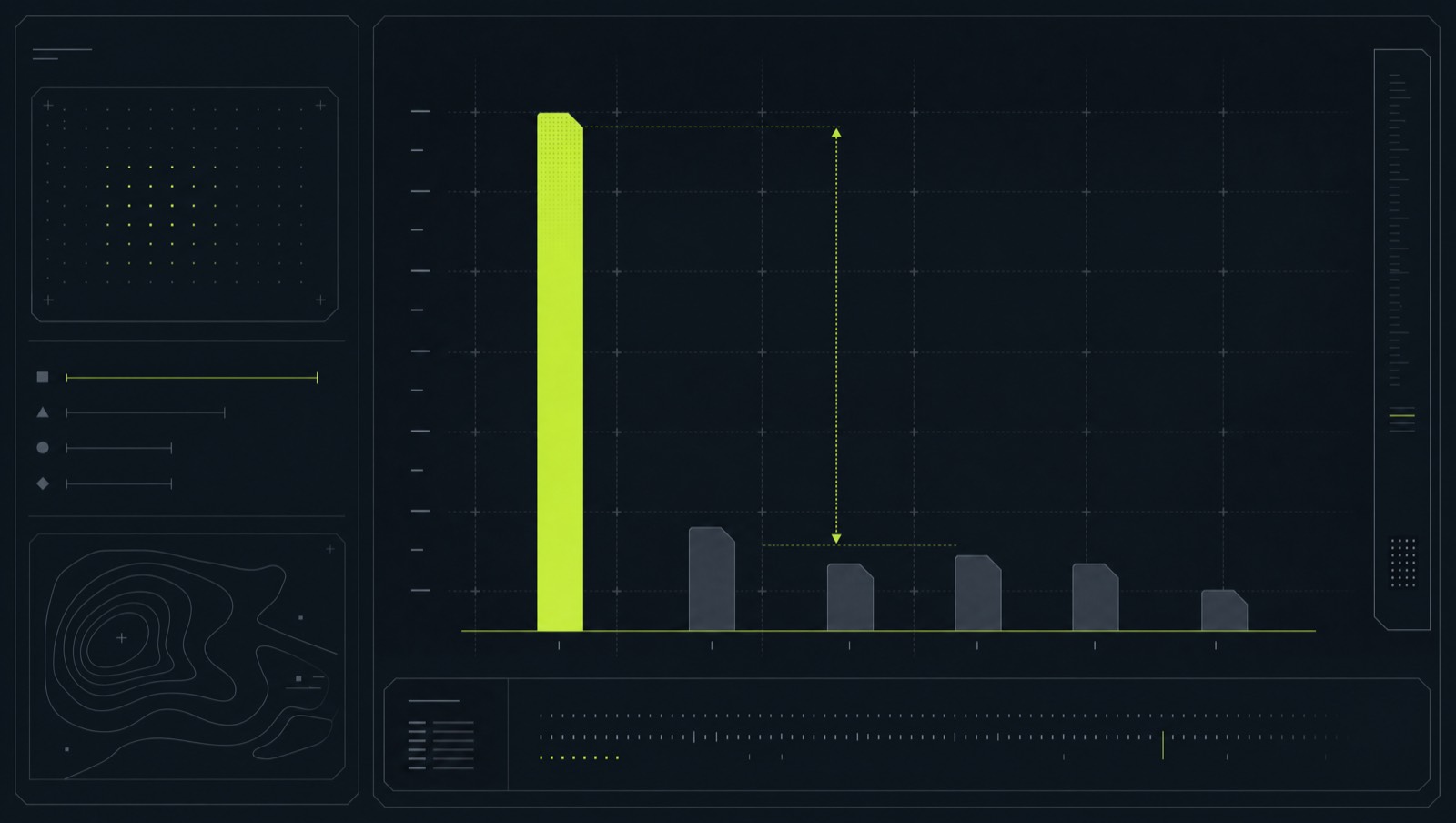
If you had to bet one dollar on a single lever to get cited by ChatGPT, which would you pick: one more backlink, or one more brand mention? The 2026 data settles it. Brand mentions correlate at 0.664 with LLM citations; backlinks, at 0.218. A factor of three in favor of the demand signal. This benchmark compares, number by number, domain authority and the demand signal as citation predictors.
- Top 3 LLM citation predictors: brand mentions (0.664), brand anchors (0.527), search volume (0.39). All off-site, all demand-related.
- Backlinks: 0.218 — three times weaker than mentions.
- Two converging studies: Ahrefs (75,000 brands) and Semrush × Kevin Indig.
- Budget consequence: shift effort from link-building to demand creation.
The predictor ranking, by correlation
First fact, and it's central: the three signals most correlated with LLM citations are all external demand signals. Your site's technical authority doesn't make the podium.
Sources: Ahrefs, analysis of 75,000 brands in AI Overviews; Semrush × Kevin Indig (Growth Memo). Classic backlinks measure 0.218 on the same kind of analysis — off the podium.
Backlinks vs mentions: the factor of 3
The contrast is worth pausing on. A brand mention — someone citing your name without even creating a link — predicts your presence in AI answers nearly three times better than a hard-won backlink.
It's counterintuitive for anyone coming from SEO: the hardest asset to acquire (the link) isn't the most predictive. The most predictive signal (the mention) requires no link at all — just that people talk about you.
The shift, over four years
The relative weight of the two signal families didn't flip overnight. It tipped as LLMs moved from indexing to inference.
Qualitative read of the predictor shift, from classic search (authority) to generative search (demand). Illustrative trend, anchored on the 2026 correlations.
Why demand wins: the mechanics
Three structural reasons explain why a demand signal beats a domain's authority in the LLM retrieval layer.
- 01LLMs reason in entitiesA model evaluates a brand as an entity present across the whole ecosystem, not as an isolated domain. An entity described consistently across 40 sources beats a single high-DR but rarely-discussed site.
- 02A mention doesn't depend on a linkModern retrieval fetches relevant text, not a link graph. An unlinked mention is an exploitable signal; historical PageRank is far less so.
- 03Demand is a proxy for relevanceIf a brand is massively searched and mentioned for a given intent, the model infers it's a credible answer. Demand volume encodes relevance better than technical authority.
What the benchmark does not say
Rigor first: a correlation benchmark has limits, and ignoring them leads to overclaims.
- +The demand signal correlates ~3× better than backlinks
- +Two independent studies converge on the same ranking
- +The top 3 predictors are all off-site
- +Link-building alone is a poor GEO bet
- −A mechanical causation (correlation ≠ causation)
- −That backlinks are useless (they serve Google SEO)
- −A citation guarantee if you raise your mentions
- −A frozen ranking — models evolve with every release
Consequence: where to place the GEO budget
If you had to reallocate tomorrow, the logic is simple: less pure link-building, more conversational demand creation.
SEO → GEO budget reallocation
FAQ
Keep reading
- LLMs feed on user searches — the postulate, in detail.
- How LLMs choose who to cite — what happens under the hood.
- AI monitoring vs active LLM Seeding — measuring the signal doesn't create it.
To create demand instead of waiting for it: How it works and Pricing.