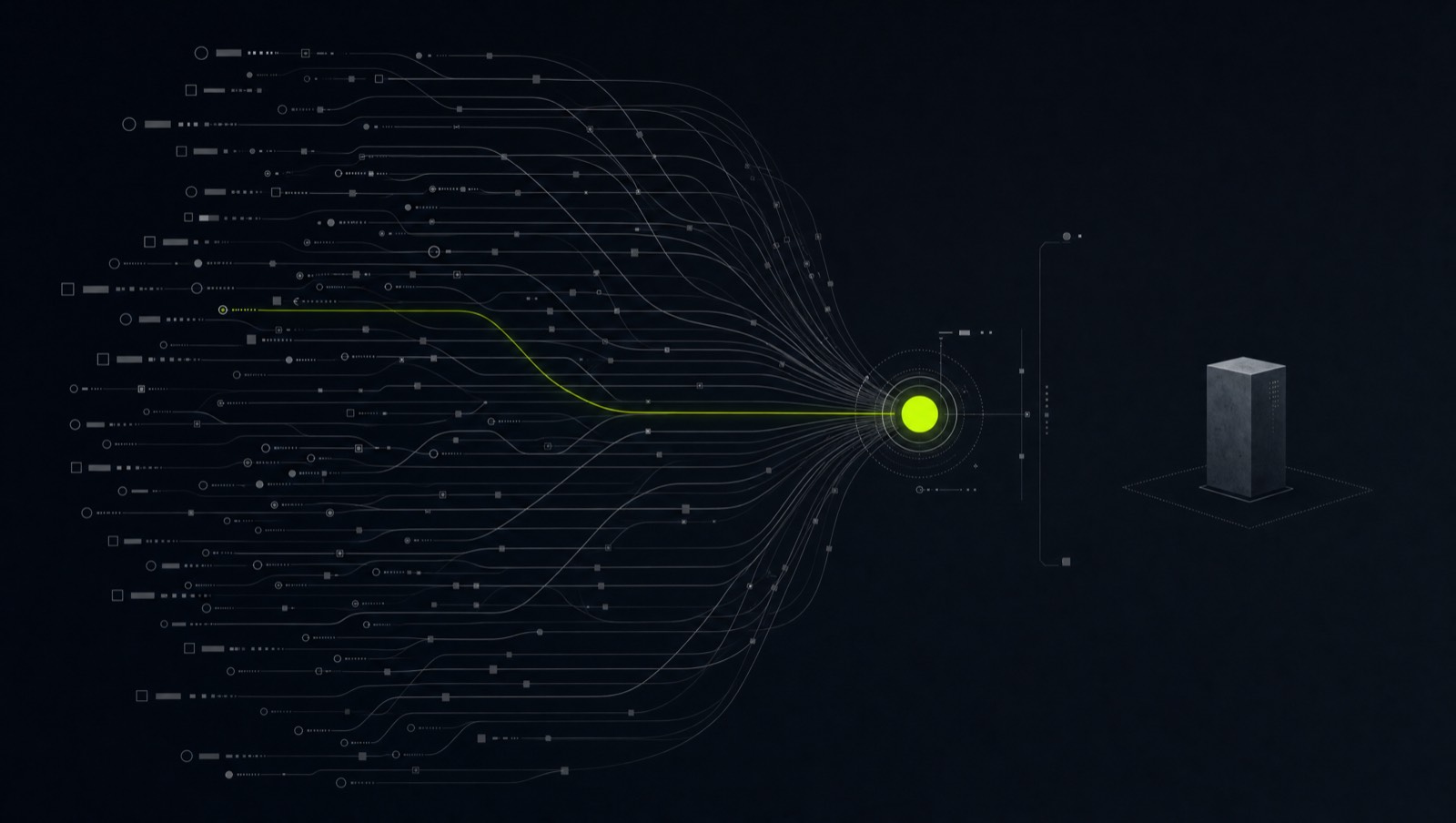
The SEO reflex is to ask: "what's my Domain Rating, how many backlinks do I have?" In GEO, that's the wrong question. What decides whether ChatGPT cites your brand isn't your site's authority — it's the volume of demand orbiting it. The searches, the mentions, the conversations. LLMs feed on that demand signal, and it weighs roughly three times more than backlinks in observed citations. This isn't an opinion: it's what the 2026 correlations show.
- Demand signal > domain authority: brand mentions correlate at 0.664 with LLM citations, backlinks at just 0.218 (Ahrefs, 75,000 brands).
- LLMs reason in entities, not domains. They cite a brand described everywhere, not a well-linked site.
- No real-time learning: your query doesn't retrain the model. It's the aggregate signal that counts.
- The actionable lever: generate conversational demand around your semantic cluster — that's LLM Seeding.
- The 4 models: ChatGPT, Claude, Grok, DeepSeek.
What do LLMs actually feed on?
An LLM doesn't cite a brand because its site is "authoritative." It cites it because the brand occupies a credible position in the information network it has digested — a signal built by demand, not by on-page optimization.
Three sources feed that signal, and none of them is your Domain Rating:
- 01The training corpusThe model ingests a web where some brands are massively discussed and others invisible. A brand mentioned across 10,000 Reddit threads, comparisons, and articles exists for the model. A DR-80 site nobody talks about does not.
- 02Retrieval (RAG)When the model fetches fresh sources, it evaluates the relevance and consistency of an entity across the ecosystem — not the strength of an isolated domain. A brand cited consistently across 30 sources is retained ahead of a single heavily-linked site.
- 03Grounding via searchChatGPT and peers sometimes lean on Bing or Google. There, branded search volume — how many people type your name — influences ranking, hence indirectly what the LLM retrieves.
The demand signal weighs 3× more than authority: the numbers
Here's the data that should reframe any GEO strategy. In 2026, two independent studies measured what actually correlates with LLM citations. The verdict is unambiguous: demand-driven, off-site factors dominate; backlinks trail behind.
Sources: Ahrefs study of 75,000 brands in AI Overviews; Semrush × Kevin Indig (Growth Memo) on AI visibility predictors. The top three predictors are all demand signals, not technical authority.
The read is clear. Brand mentions — a pure demand signal, independent of any link — predict LLM citations nearly three times better than backlinks. Domain authority, the crown metric of SEO, doesn't even reach the top three.
Domain authority vs demand signal
SEO and GEO don't measure the same world. Conflating them means investing in the wrong lever for 12 months.
Many teams transpose the SEO reflex to GEO: "I'll raise my DR and citations will follow." Wrong. A high Domain Rating gets you into the room; it's the consistency and frequency of your entity across the ecosystem that decides whether the LLM gives you the floor. Authority opens, demand speaks.
"But do LLMs really learn from my searches?"
Editorial honesty, because the nuance matters. No, an LLM does not retrain its weights on every query — they're frozen at inference. Your individual search does not modify ChatGPT.
It isn't one search that feeds the model. It's a million searches, mentions, and conversations that, aggregated, draw the map of entities the model deems credible.
That's exactly why aggregate demand beats a single site's authority. A model learns from the web as it's discussed — and the web discusses the brands people search for, not the sites people link to.
What this changes for your strategy
If the demand signal weighs three times more than authority, then the budget should follow. Here's the trade-off.
Where to spend effort in GEO
The lever nobody activates yet
Growing third-party mentions and branded search volume takes years organically. The only directly actionable lever is to generate conversational demand around your semantic cluster — to produce the signal LLMs retrieve, instead of waiting for it to appear.
That's exactly the definition of active LLM Seeding: feeding ChatGPT, Claude, Grok, and DeepSeek with natural conversations around your category's buying intents, until your brand is cited. Not monitoring — action. Not borrowed authority — created demand.
- 01ConnectRankfeed crawls your public pages and infers your brand profile plus a semantic cluster of 30 to 80 searches per language.
- 02FeedOver a 14-day warm-up, the feed generates natural conversations around those searches across the 4 models. Demand signal, industrialized.
- 03RunAt cruising speed, presence holds as long as the subscription is active. The signal doesn't decay.
FAQ
Keep reading
- Domain authority vs demand signal — the data comparison, in detail.
- How LLMs choose who to cite — the retrieval mechanics.
- The demand signal is the new backlink — how to activate it concretely.
- What is LLM Seeding? — the active lever in detail.
To turn your demand into citations: How it works and Pricing.